The Bristol Stool Chart Explained
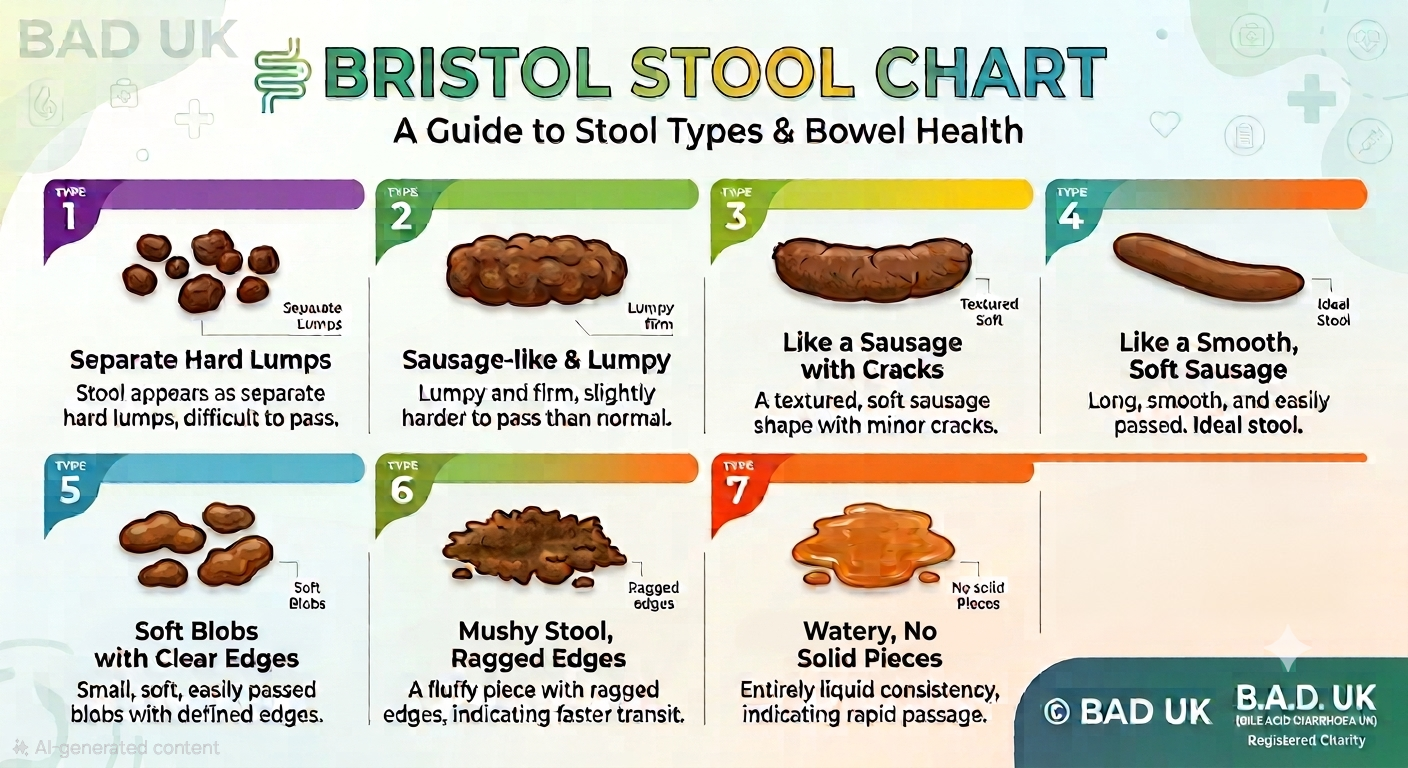
TThe Bristol Stool Chart (also known as the Bristol Stool Form Scale) is a simple visual guide that classifies bowel movements into seven types based on their shape and consistency. Developed by Dr Stephen Lewis and Professor Ken Heaton at the Bristol Royal Infirmary and first published in 1997, it is now used worldwide by healthcare professionals to assess bowel health, estimate gut transit time, and monitor digestive conditions.
For people living with bile acid diarrhoea (BAD), the Bristol Stool Chart is a useful way to monitor symptoms, assess how well treatment is working, and recognise when your bowel habit changes from what is normal for you.
The 7 Bristol Stool Types
* Type 1: Separate hard lumps – suggests constipation.
* Type 2: Lumpy, firm stool – also suggests constipation.
* Type 3: Sausage-shaped with cracks – generally considered a healthy, well-formed stool.
* Type 4: Smooth, soft sausage-shaped stool – also considered a healthy, well-formed stool.
* Type 5: Soft blobs with clear edges – slightly loose stool.
* Type 6: Mushy stool with ragged edges – diarrhoea.
* Type 7: Entirely liquid stool – diarrhoea.
What does this mean for people with BAD?
Bile acid diarrhoea occurs when excess bile acids reach the large bowel, drawing water into the gut and speeding up bowel transit. This commonly leads to loose, urgent, or watery stools, often Types 5–7 on the Bristol Stool Chart.
Many people with BAD are treated with a bile acid sequestrant (BAS) to help bind excess bile acids. As treatment begins to work, stools often become more formed, moving from Types 5–7 towards Types 3–4, which are generally considered healthy, well-formed stools.
Finding the right balance can take time. If your BAS dose is too low, diarrhoea may continue. If your dose is too high, or factors such as not drinking enough fluids, dietary changes, or other influences on bowel function come into play, constipation (Types 1–2) can develop.
The aim of treatment is not simply to achieve a particular stool type, but to reduce diarrhoea, urgency and frequency while helping you achieve the bowel pattern that is right for you.
Keeping a simple record of your Bristol Stool Chart type can help you and your healthcare team monitor your progress, identify patterns or triggers, and decide whether your treatment needs adjusting.
When should you seek medical advice?
Although changes in bowel habit are common with BAD, it’s important not to assume every new symptom is caused by your condition.
Speak to your healthcare professional if you notice: * A significant or persistent change in your usual bowel habit.
* Diarrhoea that becomes more frequent or severe despite treatment.
* New or ongoing constipation, particularly after starting or increasing a bile acid sequestrant (BAS).
* Blood in your stool or bleeding from your back passage.
* Black, tarry stools.
* Unexplained weight loss.
* Persistent or worsening abdominal pain.
* Symptoms of dehydration, ongoing fatigue, or signs of anaemia.
* Any new symptoms that are different from your usual BAD pattern.
Talking about your gut
Talking about bowel habits can feel embarrassing, but healthcare professionals discuss them every day. The Bristol Stool Chart provides a simple, shared language that makes it easier to describe your symptoms and helps your healthcare team understand what is happening.
Remember, the goal is not perfection. It is about finding the right balance for you, managing your symptoms effectively, and recognising when something changes that may need further assessment.
References: Lewis SJ, Heaton KW. Stool Form Scale as a Useful Guide to Intestinal Transit Time. Scandinavian Journal of Gastroenterology. 1997;32(9):920–924. National Institute for Health and Care Excellence (NICE). Bristol Stool Chart (adapted from Lewis & Heaton, 1997).